\n

Tour d'Afrique Ltd. | Global Bicycle Expeditions, Races and Tours

  • Icon_social_newsletter_on
    Newsletter
  • Icon_social_rss_on
    RSS Feed
  • Icon_social_twitter_on
    Twitter
  • Icon_social_facebook_on
    Facebook
  • Icon_social_youtube_on
    YouTube

Blog | Silk Route Blog Icon_16x16_light_rss RSS

What the Heck is hairtail? A Chinese Food Decoder for 2012 Silk Route Cyclists


For our first few weeks in China a lot of our meals will be in local restaurants and hotels.  When we eat as a group in China we will order for the entire group.  However when you are out cycling and want to stop at a restaurant you will need to order on your own. 

In larger towns and cities restaurants may have english menus or pictures of the food on the wall that you can point too. You can also walk around the restaurant and point at what other people are eating, a slightly embarrassing but effective method of ordering. In many of the small villages we cycle though you will have to make due with hand signals and making animal noises to place your order.
 
Smartphone owners can always use one of the travel apps we recommended in a previous post but others might find this food decoder handy.
 
Our local guide, Zabi (pictured above in the green jacket), provided us with this food decoder to help make the ordering process a bit easier.  Print it out and carry it with you on tour, I think you'll find it comes in pretty handy. 


I've reached out to Zabi to find out what 'agaric' and 'hairtail' are, if you know please tell us in the comments.  


Posted February 02, 2012 by Paul McManus
China | Ramblings
Btn_share_twitter Btn_share_facebook


The Father of the Turkmens strikes back


Updating our report on a Dog's life in Turkmenistan, it appears that plans to mothball the golden rotating statue of Turkmenistan's late eccentric dictator (pictured above) have been altered. One year after it was toppled as authorities sought to dismantle the leader's overwhelming personality cult, the statue has been placed atop a new, even higher tower.

The new tower, however, is on the outskirts of Ashgabat, not in the centre of the city as was the case previously.

See it for yourself on the 2012 Silk Route Bicycle Expedition.

Posted February 02, 2012 by Tour d'Afrique Ltd.
News Briefs | Turkmenistan
Btn_share_twitter Btn_share_facebook


Two days in Shanghai, on and off the beaten track


Spending a year in Shanghai is by no means enough to extensively explore this wonderful city, its neighborhoods, it’s idiosyncrasies.  

The first and most natural place to start for first-time visitors is People's Square (Ren Min Guang Chang), a beautiful square downtown Shanghai surrounded by green and some of the city's nicest architecture. In its very heart, a mandatory stop is Shanghai Museum (Shang Hai Bo Wu Guan), a splendid display of Chinese past and present, lifestyle and art, calligraphy and handicraft, in a nutshell, a full immersion in the country's intimate soul. Despite being in the city center, Shanghai Museum doesn't draw the attention it should, and often its visitors are more Chinese than tourists.  


The natural continuation from People's Square is the Old City and the Yu Garden (Yu Yuan). This can be a bit of a tourist trap, but it's by all means a must-see for first-timers as, especially in the Yu Garden, typical Chinese architecture and gardening style are beautifully displayed. Inside the Old City there are many shops offering anything from souvenirs to traditional clothes to fancy chopsticks, but tourists should be aware that the first price is “for foreigners”, meaning that if you can pay a tea set 100-150 Yuan at a normal shop, there it can cost 800 Yuan. This being said, you can (and are expected to) bargain the price. It's very easy to get to the Old City by taking subway line 10 and getting off at the Yu Yuan stop. Take exit 1 and after a short walk you will see the crowd.
 

Who is keen on museums can also take a look at the places symbol of the Communist Revolution by visiting the Site of the First National Congress of the Communist Party of China situated at no. 76 Xingye Road, next to the trendy pedestrian area Xintiandi. Attracting millions of visitors every year, the Site represents a fascinating journey into a lesser known part of the country's modern history, with an impressive reproduction of the first meeting in the living room on the first floor. Admission is free.

To get here, take metro line 1 and get off at South Huangpi Rd (Huang Pi Nan Lu). Station. Take exit 2 and walk along South Huangpi Road up to Xingye Road on your right side.
 

Shanghai's multifaceted society makes it for a very intriguing place to explore. Apart from shopping malls and museums, there's another side of the city that doesn't get all the attention it should. It's the spiritual scene of a world that has suddenly entered modernity but that is proud to cling onto its strong beliefs and the philosophy that made it one of the greatest civilizations.
 

Also when it comes to temples, visitors will stumble both on proper tourist destinations and in unsung pearls of Chinese culture. Three unmissable sights of this kind are around the city center.
 

The first, easy to find, is Jing'an Temple (Jing An Si), in West Nanjing Road (Nanjing Xi Lu). With a history that dates back to almost 800 years ago, this is one of the main worship areas in Shanghai. It consists of three main halls finely decorated with jade Buddhas and his relics, as well as fresh flowers and the constant scent of incense lit up by the never-ending  flow of worshipers. An attentive eye will notice that its traditional architecture is in striking contrast with the high modern-looking buildings and shopping malls that sit just beside. As crowded as Jing'an Temple is the Jade Buddha Temple (Yu Fo Si,) that, as the name suggests, displays two wonderful jade statues of the Buddha. Packed with tourists and worshipers, this temple is a pleasure to visit whether you are a Buddhist or not thanks to its magical atmosphere that makes for an enchanting break from the hassle and bustle of outside modernity.  


A true hidden gem within Shanghai's spirituality is the Confucius Temple (Shang Hai Wen Miao) situated in Wen Miao Road (Wen Miao Lu). Beautiful display of Chinese culture inspired by Confucius' philosophy, the gardening style plentiful of rocks shows the importance nature held in his ideology as well as the influence he had on Chinese civilization. The temple might be a little hard to find as Wen Miao Road is a small alley off the main South Xizang Road (Xi Zang Nan Lu but it's definitely a must. The nearest metro station is Loaximen on line 10.  

Traveling to Shanghai, and China in general, for the first time isn't easy. The main hindrance is the language. Not many Chinese speak a fluent, or any, English, and Mandarin isn't exactly a language Westerners can pick up easily. It's therefore recommended to bring a small glossary with you so that you can point the characters of the essential stuff you may need. For  smartphone users there are some great apps to help you like Jibbigo and Pleco.
 

Going to eat is usually quite straightforward, as most restaurants have their English-version menu, but if you are a complete vegetarian you can find some problems since in Chinese cuisine meat is added about everywhere, to the extent that sometimes they don't consider a meat-based dish if it contains only small pieces of pork or chicken. This is why, if you don't want to eat any kind of meat you will need to tell them first, then specify all the ingredients you don't want:
 

-
I don’t eat meat: Wo bu chi rou
-
I don’t want pork: Wo bu yao zhu rou
- I don’t want beef: Wo bu yao niu rou
- I don’t want chicken: Wo bu yao ji

- I don’t want fish: Wo bu yao yu
 

Transport is not a problem, as the wide and well-organized metro lines make it very easy to get around anywhere in the city. It's important to make sure you have an up-to-date subway map in English language instead of the Chinese version, possible to find at the main metro stations. In all stations names are both in Chinese and English. In case you want to take a taxi, they are very cheap and available everywhere, but again, drivers don't speak English, and often they won't understand which road you want to go to, so it's always a good idea to have the destination written in Chinese characters.  

The first period in China is a challenge, but once the ice is broken, the country reveals itself as a wonderful destination to be explored, unearthing its hidden gems and fast-paced evolution.
 

More Articles from Angela:

●    Speaking Mandarin - Must Know Expressions - a 6 part series
●    The Jade Buddha Temple in Shanghai
●    Shanghai's Display of Communism

This guest post was written by Angela Corrias. Angela is a freelance journalist. She specializes in travel writing with the aim to combine her passion for travelling with a socially aware writing. She regularly updates her travel website Chasing The Unexpected.


Visit Shanghai on our 2012 Silk Route Bicycle Expedition.

Posted January 19, 2012 by Guest Author
China | News Briefs
Btn_share_twitter Btn_share_facebook


A Giant List of Tips in No Particular Order for 2012 Silk Route Riders


I learned a lot of things on my scouting trip to China.  Here is a random assortment you may find helpful if you are joining us on our Silk Route Bike Tour.  These tips obviously apply to China. I'll share some tips for the other 6 countries we'll be riding through later on.

-Shanghai has two airports.  One is largely domestic, the other largely international (but not exclusively).  Be sure you know which one you fly into because they are 30 km apart.
 
-Most of our hotels in China do not have laundry service.  Local laundries require 24 hours to wash your clothes. 

-Don’t ever stop in middle of a road/bike path, unless you are fond of being run over by an electric scooter.

-Bring a bell or horn.  A really loud one. Also bring mirror and handlebar bag that has a map case.

-Wean yourself off of coffee before coming.  Get used to drinking tea. 


-Carry the name of each hotel we stay in written in Mandarin with you each day. Believe me, at some point this will save your ass.  Especially if you follow the advice at the end of this list.

-Internet in most of the hotels we stay in is cable only, no wifi, so iPad and Mac Air users are out of luck

-If you enter your hotel and the lights don’t work it is because you didn’t insert your key card into the automatic cut off switch at the door.
 
-Hotels charge for dirty towels and sheets.  A lot.  They will check your room thoroughly before you check out. So don't clean your bike with a towel and don't steal anything.


-SIM cards and phones are cheap in Shanghai, you should plan on getting one.

-Every time you take a cab take a picture of the cab’s ID and phone number, just in case you forget something.

-You will have to carry your bags upstairs at most hotels in China so pack accordingly.

-Always carry toilet paper. (this is a good rule for all our tours actually).

-If you don’t like noodles, I hope you like rice.


-Drink bottled water or boiled water.  A lot of the water is not safe to drink.

-Learn to use chopsticks. Long chopsticks were easier for me to use than short ones. Wooden ones were easier to use than plastic or metal. I've heard the reusable plastic chopsticks restaurants use are rarely cleaned well so its best to use the disposable ones or bring your own.

-Buy a filter mask for dust and smog (if you have allergies or asthma take extra precautions)

-No skinny tires.  All tires should be 28mm or wider.  You've been warned.

And Finally: Get lost! It’s fun and China is very safe and fun to explore.  Just get found again before I have to come looking for you!

Well there you go.  I told you they were assorted!  More coherent info about preparing for the Silk Route Bike Tour coming soon, including a food decoder and some awesome language tips. 

Been to China?  Have some tips of your own?  Love to hear them in the comments.

Paul


Images via Wikipedia


Posted December 31, 2011 by Paul McManus
News Briefs | Ramblings | Tour Updates
Btn_share_twitter Btn_share_facebook


6 Quick Links: Silk Route 2012


I read a lot of things about the Silk Route these days.  Here is a selection of a few posts from my favorite travel bloggers and one bonus link I think is just a neat idea.  If you like what you read, please let these bloggers know in the comments.

Turkish Recipies -
From the Expat blog Turkeys for Life.  These guys post some great pics and stories with insights from their lives in Turkey.http://www.turkeysforlife.com/2011/12/turkish-food-recipes-2011-favourites.html

Tehran Markets, in Pictures -
From Angela Corrias at Chasing the Unexpectedhttp://www.chasingtheunexpected.com/2011/10/tehran-in-pictures-local-markets-and-sweets-shops/

Beautiful Panoramic Photo of Shah-e-Cheragh Mosque in Shiraz, Iran
 - from Uncornered Market, check out all their posts, the pictures are fantastic!http://www.uncorneredmarket.com/2011/12/shah-cheragh-mosque-shiraz-panorama/


           Karakol Lake - photo by Christine McDonald

Cycling the Pamir Highway -
10 Questions with Christine McDonald on Travelling Two's blog.  Great stories and advice from people who have been there and done that. http://travellingtwo.com/resources/10questions/pamir-highway

Video of Turpan, China
 - Not a travel blog but a series of videos from the Silk Road Music Project.  Part 10 of a series. http://www.youtube.com/watch?v=6sEWIKW15Ss&feature=youtube_gdataBonus Link:

The Worlds Cheapest (and lightest?) Multi Tool for bike repair - DIY -
http://www.biketinker.com/2011/projects/worlds-cheapest-multi-tool/

Posted December 29, 2011 by Paul McManus
News Briefs | Ramblings
Btn_share_twitter Btn_share_facebook


China Silk Route Scouting Photos


Silk Route Tour Leader Paul McManus took some nice photos while scouting the new route from Shanghai to Xi'an. Check them out here, here and here.

Posted December 24, 2011 by Paul McManus
China | Tour Updates
Btn_share_twitter Btn_share_facebook


Black Boogers and Shaolin Priests


Right now I am wearing gloves in my hotel room just outside Dengfeng, China. The 70 CNY ($10) hotel we’ve chosen for the tour might be lacking a few of the finer things (like heat) but it does have one advantage, it is located 300 meters from the gate of the famous Shaolin Temple, birthplace of KungFu. 

I’m here scouting the new route of the 2012 Silk Route Bike Tour.  In 2012 the tour will run East to West (a much better direction) and it will start in Shanghai and finish in Istanbul. 

Fortunately for us when we bike through here on tour in 2012 the weather will be warm so the heat will not be a problem.  And the hotel is not without its charms.  It is run by a very nice Chinese family and has hot showers and internet.  The restaurant downstairs serves a wicked stir fired rabbit, complete with paws and face  (it’s surprisingly hard to eat a rabbit when you’re looking at its cooked face). 


Why do Monks a Priests Always put their temples at the top of a Mountain?

The ride into Dengfeng is a long one, about 150 km with a few good hills to finish the day (I know how much riders just love it when camp is at the top of a long climb).  The Temple is surrounded by mountains, a welcome relief from the rest of eastern china, which has been pathetically flat thus far.  The Shaolin Temple is located only 300 meters from our hotel and riders will have plenty of time to visit it in the morning before our short ride of 60 km to our rest day in Luoyang

Figuring I could see the Shaolin Temple when I return on tour, I took some time to climb to another nearby temple, the Songshan Temple.  The hotel owner told me it was difficult to get to but really that only made we want to do it more.  In my experience the more difficult something is to get to, the more rewarding the experience usually is.


Stair Master

A six kilometer long flight of stairs leads to the temple.  It was tough.  My guide dropped off after about a km of climbing.  I told him I would only go a little further then come back, I think we both new I was lying.  I wanted to reach the top. 

After about 2 kms the route begins to hug the mountain side, dip under rock ledges and cross some impressive gorges.   I felt a little like Frodo climbing to Mordor, save for the big fiery eye at the top. I was alone on the steps at seven in the morning and for two hours I climbed without seeing or hearing anyone but the wind and birds (a real treat after two weeks in China, which is never quiet). 

At the top the Temple was under renovation.  The grounds were full of stone cutters and carpenters hard at work in the chill air.  The temple itself was pretty impressive.  But more impressive were these guys

In the video it’s hard to see, but what you are witnessing is a group of about 15 men trying to drag what must be a 500 kg brass bell up to the top of the mountain.  And all the while that they are trying to heave this thing up one step at a time other men are passing them with 50 kg sacks of sand on their heads!  Made me feel a little silly for being winded at all. 


500 Yards of Foulness

"Andy crawled to freedom through five hundred yards of shit-smelling foulness I can't even imagine. Or maybe I just don't want to." -  Morgan Freeman in Shawshank Redemption

Before reaching Dengfeng riders will have to cycle through the city of Gao Zhou and I imagine that quote will resonate with them more than ever. 

Gao Zhou is perhaps one of the dirtiest cities I have ever visited in my life.  The streets are muddy and the air is filled with cement and coal dust from half dozen mines and factories that surround the city.  Everything is coated in a thick grey layer of dust. The landscape has been stripped bare in China’s search for resources to build the infrastructure to support 20% of the world’s population.  The dry air, mixed with all that dust gives you some pretty epic boogers. 

But riding through the city will only take an hour of so and soon the mountains that surround the Temples near Dengfeng will come into view and the road will improves. You climb into the mountains past centuries old temples and parks and up to the Shaolin Temple where a giant statue of a Monk greets you and humbles you.

All in all, I think it will be a pretty good day of riding. 

Here are some more photos of the area:


Posted December 15, 2011 by Paul McManus
China | Ramblings
Btn_share_twitter Btn_share_facebook


Woof! Woof! A dog's life in Turkmenistan.


The rather eccentric leader of Turkmenistan, Saparmurat Niyazov, (who renamed months of the year after himself and members of his family) may have passed away in 2006 but his successor, Gurbanguly Berdymukhamedov, is staying in character by keeping a close eye on the country's dog population.


The statue of Saparmurat Niyazov (pictured above) was designed so that his face turned and followed the sun on its journey across the sky.

Visit this intriguing country on a bicycle by joining the 2012 Silk Route.

Thanks to Paul Davison for sending us this story.

Posted December 09, 2011 by Tour d'Afrique Ltd.
News Briefs | Ramblings | Turkmenistan
Btn_share_twitter Btn_share_facebook


What Can a Venture Capitlist Teach You About Samarkand?


Most people in Samarkand, including emperor Timur could not read these as they were illiterate.

As it turns out quite a lot!

Especially if he was just there, as our guest author Ashok Vaish was.  He recently visited Samarkand with his family and his blog does a wonderful job of outlining some of the history and events that have impacted the city. He also highlights his words with some very nice photos.  Enjoy!

Samarkand

by Ashok Vaish

Samarkand has been at the center of many empires. Here’s a list for the history buff:

The Achaemenids (6th – 4th Century B.C.)
The Greeks with the conquest by Alexander the Great
(4th Cen. B. C. on)
Kushan  - A Greco-Indian Buddhist empire.
(1st – 3rd Century A.D.)
Sassanid – a Persian dynasty. Zoroastrian, Buddhist
(3rd-7th Century)
Arab – briefly part of the Caliphate after muslim conquest in eighth century.
Samanid – a Persian, Shia empire (9th and 10th Century)
Turkic Sunni Muslim rule from the Aral Sea kingdom of Khwarezm (11th -13th Cen.)
Completely destroyed, burned and looted by Genghis Khan (March 1220)
Rebuilt by Timur Lang, a descendant of Genghis
(14th Century)
Timur Lang and his dynasty (14th – 16th Century)
Uzbeks, Bukhara Emirates (16th – 18th Century)
Tsarist Russia and Soviet colonization. (19th & 20th Century)
Independent Uzbekistan (1991 – present)

Timur Lang’s monuments define Samarkand today. They have been restored somewhat from the ravages of time and violent cultures since the 14th century when they regally dominated the Samarkand skyline.

Timur’s Mausoleum


Timur ruled from 1370 – 1405. He saw himself as Genghis Khan’s heir and was a great conqueror in the Mongol tradition: a brutal destroyer, sacker and looter across Asia. But he was also a builder of a beautiful city and a patron of the arts. In 1404 he lost his favorite grandson in a battle and was devastated. Timor, the  murderer of more than a million people, is said to have cried for two days. He built this mausoleum in memory of his grandson. He is buried here too along with his other descendants.

The tombs inside the Mausoleum

There is a famous curse attached to opening Timur’s tomb: A sign is carved on it warning that whoever would dare disturb the tomb would bring unspeakable horror onto his land. The tomb lay unopened for 500 years.  On June 19, 1941 a Russian expeditionist, Mikhail Gerasimov, opened the tomb. Three days later he learned of the Nazi invasion of Russia which resulted in 30 million Russians being killed!
Other things to See in Samarkand:
Registan Square

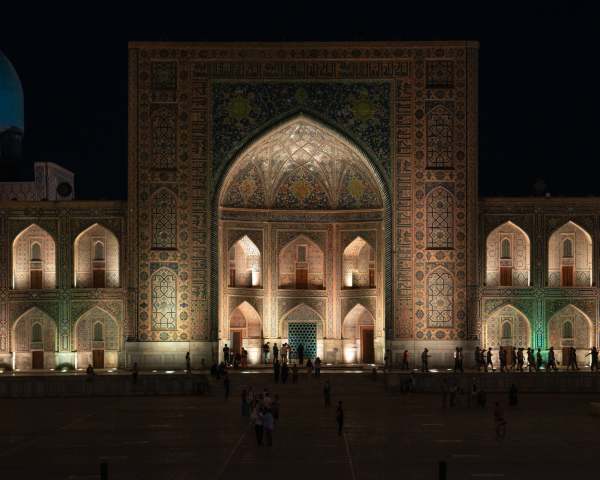
Registan Square, Samarkand


This was the center of the city of Samarkand, built in desert motifs and consisted of places of worship and public discourse. It was a great bustling place with colleges teaching philosophy, math and astronomy as well as a silk route bazaar with eclectic wares from across Timur’s empire – from India to Persia and beyond.
Bibi Khanum’s Mosque

Timur built this mosque in memory of his wife, Bibi Khanum, in 1399 after he returned from his Indian campaign, where he sacked and looted Delhi, India, because “the sultanate there was too tolerant toward its Hindu subjects”.

He brought back more than 50,000 prisoners and 95 elephants who helped build this mosque with Indian architectural elements. Timur’s great grandson, Babur conquered India in 1526 founding the Moghul dynasty which ruled until 1847.

A huge stone Koran dominates the center of the square.

The whole complex is being restored with Russian assistance, a process that began in Soviet times.

Shah-e-Zinda Tombs


This is a beautiful necropolis not far from the Bibi Khanum mosque, where legend has it that Kusam ibn Abbas, prophet Mohammed’s cousin is buried. He came to Samarkand in the seventh century to preach Islam and was murdered by the Zoroastrians. His tomb was regarded for a long time as a pilgrimage site, equivalent to Mecca for those who could not afford the journey to Arabia.

Samarkand’s Bazaar


A bustling market of delights in Samarkand. Colorful dresses, scarves and headwear distinguish the vendors of fruits, vegetables, almonds and black sweet raisins.

Potatoes, potatoes.. selling New World food on the Old Silk Route

Big Thanks to Ashok for writing this wonderful post and sharing it with us! 

Related Links:

Info about our 12,000 km Silk Route Bike Tour from Shanghai to Istanbul:

http://tourdafrique.com/tours/silkroute/overview

An explanation of Confirmation Bias by one of my favorite blogs, You Are Not So Smart:

http://youarenotsosmart.com/2010/06/23/confirmation-bias/

Link to the original blog post by Venture Capitalist Ashok Vaish:

http://ayecapitalist.com/2011/10/21/samarkand-an-oasis-of-exotic-delights-on-the-old-silk-road/#comments

Posted November 18, 2011 by Paul McManus
News Briefs | Ramblings
Btn_share_twitter Btn_share_facebook


Designing from Bones – Ancient Silk Route


                           Silk worm cocoons

There are lots of things to get excited about on our Silk Route tour.  Obviously the cycling is a big reason for joining a 4 and a half month bike tour (I hope!), but there are a lot of reasons people choose to travel by bike.  

Reason like experiencing new cultures and learning new languages,  the local people you’ll meet, your fellow riders, the scenic beauty, the exotic foods and of course since this is a Tour d’Afrique Ltd adventure tour you can expect a few challenging surprises along the way. 

Bike tours are always better when you know a bit about the history, culture and language of the places they travel through.  So when I came across this blog post by science fiction writer Gene Lemmp I thought I’d share it with you.  What does a science fiction writer have to say about the history of the Silk Route?  Well a lot actually.  Gene uses history to inspire the plots and characters of his own stories.  And the silk route is rich with stories of human drama and exploit. 

It’s a worthwhile read and should spark your imagination as to what lies ahead for us as we start our own journey on the Silk Route Bicycle Tour starting in May 2012. 

I’ve included a abbreviated version of the full post below, please click though to read it in its entirety.  When I contacted Gene about using his story, he mentioned he will be working on similar stories about the silk route in the future.  I hope that’s true and I hope he shares them with us!  Thanks to Gene for the great words. 

--- Paul McManus, Silk Route 2012 Tour Leader


Designing from Bones – Ancient Silk RouteThe Silk Road consists of many land and sea routes


Trade grew from the need of civilizations to acquire goods and resources not available in their home regions. This trade was often driven by empires, conquerors and religious establishments.

The Chinese held one vital resource, silk, and readily traded it for a wide variety of required goods and treasure over the following 500 years. However, the Chinese silk monopoly ended in the 3rd century when two Christian monks discovered the secret of making silk and spies were sent to steal precious silk worm eggs. Not long after silk began to be produced in the Byzantine Empire and the Silk Route drifted out of use, giving way to Islamic-controlled routes.

Conquerors, Adventurers and Death

A new conqueror, this time Genghis Khan and his Mongol hoard, re-established the Silk Route from the early 1200′s until the mid to late 1300′s. During the interim the Islamic trade routes had held a stranglehold between Europe and Asia but they could not resist the power of the Mongols. Genghis breathed life back into the Silk Road and it thrived.

Two famous travelers moved along the Silk Route during this era. One a much lauded noble traveler and the other a far more insidious and ignoble traveler.

The first was Marco Polo, a Venetian explorer, although he was only 17 when he and his father and uncle, a successful merchant team and headed along the route for China. Marco would end up traveling both the land and sea segments of the Silk Route through China to modern day Burma and back. For 24 years, Marco and his companions adventured through foreign lands before returning loaded with a wealth of treasure and knowledge.

The second famous traveler of the Silk Route during this era was the Black Death (commonly known as the Bubonic plague although this connection is in dispute). Many studies feel that the Black Death moved along this famous trade route from China to Europe most likely carried by merchants or the rats that hitchhiked with every caravan of the era. The Black Death led to the deaths of approximately half of the European population and changed the course of Western history forever.

Cultural Exchanges

While the need for goods spawned the Silk Route it was humans that transported those goods. As such the route served as a primary exchange of culture between the West and the East with Central Asia acting as a centralized stew pot of ideas, art, technology and religion.

The route allowed Christianity to advance as far as China while Buddhism missionaries traveled from India with caravans reaching into China and Central Asia. Caliphates of Arabia introduced Islam along the Silk Route in the 7th century and at one time the three great religions brewed together in the melting pot of Central Asia.

Alongside of religion moved art, paper, architecture, music, sculpting, dance and theater. It is easy to see in some areas of what we now call the Middle East the wide variety of cultural influences that at one time blossomed here.

You can read the Gene’s post in it’s entirely on his blog.
 
Gene Lempp is a science fantasy and science fiction writer with interests in archaeology, history and astronomy.  In his spare moments of lucidity, Gene blogs about the uses of history and archeology in discovering story through his Designing from Bones series, reads every craft book he can find and roams worlds where science becomes magic and power evolves from the human spirit.

Posted October 26, 2011 by Paul McManus
News Briefs | Tour Updates
Btn_share_twitter Btn_share_facebook